REGOLO: first hardware pass
2026-07-02
REGOLO is a 10-channel USB control surface designed to make software-based audio mixing feel physical again.
Instead of processing analog audio directly, the device exposes ten independent hardware channels to a host computer. Each channel combines a potentiometer for continuous control, a dedicated mute switch, and a status LED for feedback. The PC side is then free to map those controls to system volume, microphones, browser audio, music playback, voice chat, DAW channels, or any other virtual bus.
What the project is trying to solve
Desktop audio setups are often fragmented.
You may have system output, one or more microphones, browser audio, music playback, Discord, OBS, a DAW, and a couple of virtual buses all active at the same time. Software can route all of this, but day-to-day control is still awkward because it usually means switching windows, opening per-application mixers, or relying on keyboard shortcuts that do not scale well.
Existing hardware for audio control often includes useful but not strictly necessary features, which can push the price into a range that feels excessive for many users. REGOLO aims to be an open source alternative focused on the core controls that matter most.
REGOLO moves that interaction back into hardware:
- one physical control per channel
- one mute action per channel
- immediate visual feedback
- a simple USB connection to the host machine
The result is not an audio mixer in the analog sense, but a dedicated hardware front-end for software audio control.
Current hardware direction
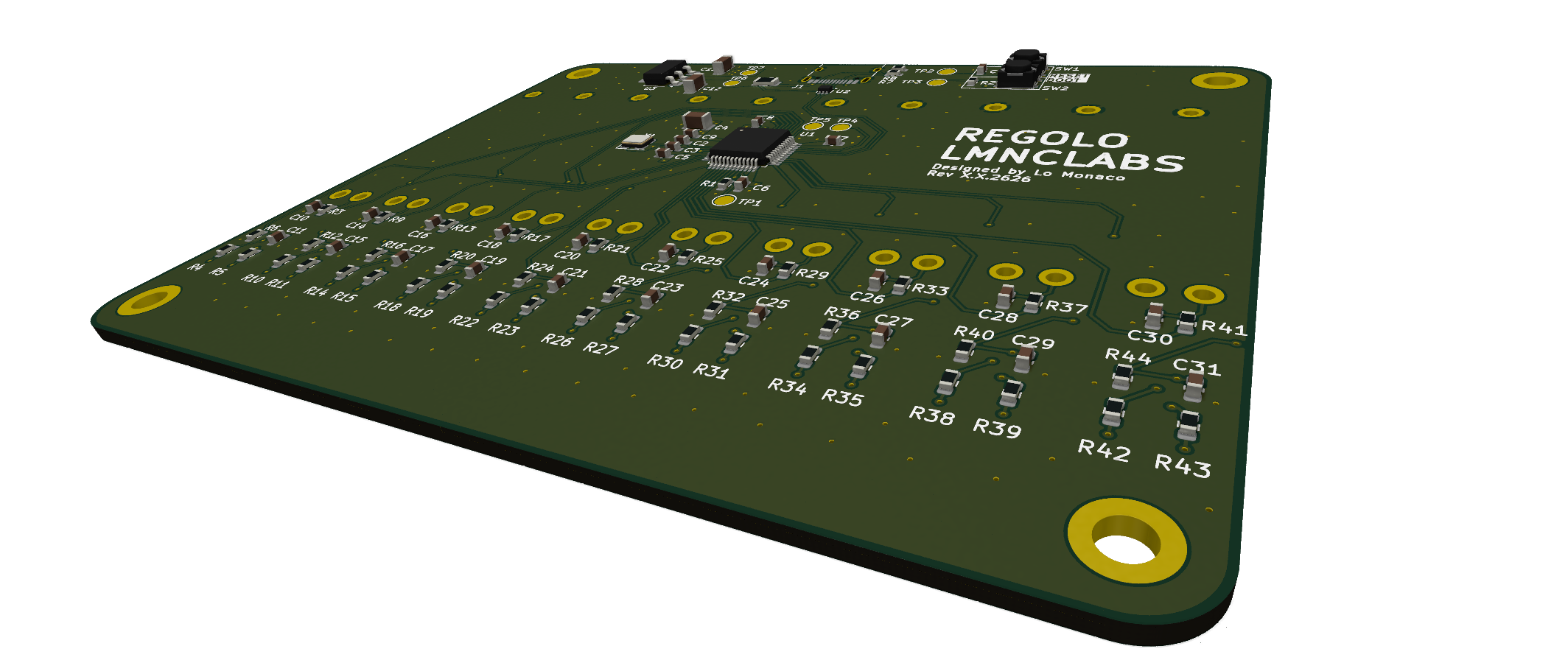
The current repository already defines the hardware architecture in KiCad.
At the center of the design there is a WCH CH32V203, chosen for its integrated full-speed USB support and a peripheral set that fits the project well. Around it, the board replicates the same control block ten times.
Each channel currently exposes:
- an analog output from the potentiometer
- a digital mute switch signal
- a status LED control line
The USB and power section includes:
- a USB-C connector for USB 2.0
- ESD protection on the data lines
- a polyfuse on the power input
- a 3.3 V rail generated by an
AZ1117CH2-3.3
That makes the board look like a clean bridge between physical controls and host-managed audio logic.
Firmware and software split
One of the most interesting aspects of REGOLO is the separation of responsibilities.
Hardware
The board is responsible for:
- sampling ten potentiometers
- reading ten mute switches
- driving ten status LEDs
- presenting itself to the host over USB
Host software
The computer side is responsible for:
- mapping channels to applications or buses
- translating hardware events into volume changes
- handling mute state logic
- deciding how LEDs should reflect channel state
This split keeps the device simple and focused while leaving room for different host-side integrations later.
Repository status today
At the moment, the public repository is mainly focused on the hardware design.
Already present:
- KiCad project files for the main board
- modular schematics for channel, MCU, and USB sections
- local symbols and footprints for the custom hardware
Still expected in future revisions:
- firmware implementation in
firmware/ - host-side software that maps USB events to actual audio controls
Why it is interesting
REGOLO sits in a nice space between embedded systems, open hardware, and desktop tooling.
It is not just a PCB exercise: it is also an interface design problem. The usefulness of the project depends on how naturally hardware controls can be connected to real software workflows like streaming, remote meetings, music production, or multi-application desktop audio routing.
That makes it a strong candidate for iterative development: hardware first, firmware next, then host integration.
Links
- Repository: ndr-lmnc/regolo
- License: CERN-OHL-S-2.0 for hardware, MIT for firmware